The $199 Phone

Posted by muamar Jumat, 30 Agustus 2013 0 komentar
It's hard to believe that a high-end smartphone can cost only $199 without contracts and carrier subsidies. Nexus 4 was released last year and its specs don't look that great when you compare it with phones like HTC One or Samsung Galaxy S4, but Nexus 4 runs the latest Android version, it has a smooth interface and many developers use it to test their apps.

From $299 to $199, Nexus 4 managed to become the first high-end smartphone that costs less than $200 off contract. Google's previous Nexus phones used to cost about $529, but Nexus 4 changed all that. Google subsidized the phone in an effort to make the phone more affordable.


It's amazing to see how much has changed since 2010, when Google released the first Nexus device: Nexus One. Hardware has improved a lot, Android has a great interface, Android apps are better, Google built a content store, Android is the leading mobile OS and you can buy powerful phones and tablets for about $200 (full price).

Baca Selengkapnya ....

Google Earth Tour Builder

Posted by muamar 0 komentar
Google has a new experimental service that lets you build Google Earth tours from your browser. It's called Tour Builder and it requires the Google Earth Plugin (you also get the plugin when you install Google Earth).

"Tour Builder is a new way to show people the places you've visited and the experiences you had along the way using Google Earth. It lets you pick the locations right on the map, add in photos, text, and video, and then share your creation. We originally created Tour Builder to give veterans a way to record all the places that military service has taken them, and preserve their stories and memories as a legacy for their families. But we also thought it could be a useful tool for anyone with a story to tell, so we made it available to everyone," explains Google.


Before creating a tour, you can check the gallery:


Tour Builder lets you add images and videos, import KML files, enable or disable some layers, add historical imagery. By default, tours are private, but you can share them with other people.


{ Thanks, Florian K. }

Baca Selengkapnya ....

New Google Sign-in Page for Mobile Devices

Posted by muamar 0 komentar
Google's mobile sign-in page has a new interface that uses the same slogan from the desktop: "One password. All of Google." It's a more crowded page that includes a silhouette icon, a list of icons for Google services like Gmail, YouTube, Google Maps and a small "Create an account" link at the bottom of the page instead of the red "sign up" button.


Here's the old interface:


For some reason, the new sign-in page lacks the "stay signed in" checkbox.

Baca Selengkapnya ....

Knowledge Graph Reminders

Posted by muamar 0 komentar
If you search Google for music artists, actors, books, TV shows and you're logged in, you'll see a new "Remind me" button in the Knowledge Graph card. Click the button and "Google Now will remind you about new releases/movies/episodes on your phone or tablet".


Until now, you could add time-based and location-based reminders to Google Now. These new reminders are special and can only be added from Google search. You can manage them from the Google Search app on your mobile device: just go to Settings, My Stuff and select Reminders.


This feature was added last week, when the Google Search app for Android was updated.

Baca Selengkapnya ....

RenderScript Intrinsics

Posted by muamar Kamis, 29 Agustus 2013 0 komentar


Posted by R. Jason Sams, Android RenderScript Tech Lead


RenderScript has a very powerful ability called Intrinsics. Intrinsics are built-in functions that perform well-defined operations often seen in image processing. Intrinsics can be very helpful to you because they provide extremely high-performance implementations of standard functions with a minimal amount of code.


RenderScript intrinsics will usually be the fastest possible way for a developer to perform these operations. We’ve worked closely with our partners to ensure that the intrinsics perform as fast as possible on their architectures — often far beyond anything that can be achieved in a general-purpose language.


Table 1. RenderScript intrinsics and the operations they provide.


NameOperation
ScriptIntrinsicConvolve3x3, ScriptIntrinsicConvolve5x5Performs a 3x3 or 5x5 convolution.
ScriptIntrinsicBlurPerforms a Gaussian blur. Supports grayscale and RGBA buffers and is used by the system framework for drop shadows.
ScriptIntrinsicYuvToRGBConverts a YUV buffer to RGB. Often used to process camera data.
ScriptIntrinsicColorMatrixApplies a 4x4 color matrix to a buffer.
ScriptIntrinsicBlendBlends two allocations in a variety of ways.
ScriptIntrinsicLUTApplies a per-channel lookup table to a buffer.
ScriptIntrinsic3DLUTApplies a color cube with interpolation to a buffer.


Your application can use one of these intrinsics with very little code. For example, to perform a Gaussian blur, the application can do the following:


RenderScript rs = RenderScript.create(theActivity);
ScriptIntrinsicBlur theIntrinsic = ScriptIntrinsicBlur.create(mRS, Element.U8_4(rs));;
Allocation tmpIn = Allocation.createFromBitmap(rs, inputBitmap);
Allocation tmpOut = Allocation.createFromBitmap(rs, outputBitmap);
theIntrinsic.setRadius(25.f);
theIntrinsic.setInput(tmpIn);
theIntrinsic.forEach(tmpOut);
tmpOut.copyTo(outputBitmap);


This example creates a RenderScript context and a Blur intrinsic. It then uses the intrinsic to perform a Gaussian blur with a 25-pixel radius on the allocation. The default implementation of blur uses carefully hand-tuned assembly code, but on some hardware it will instead use hand-tuned GPU code.


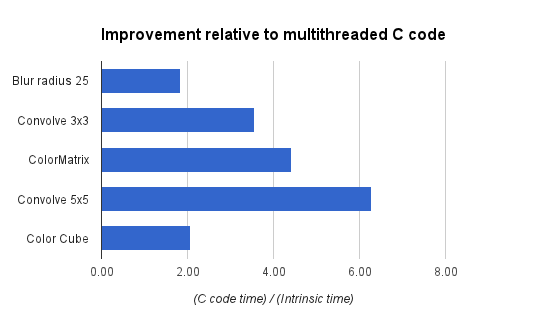
What do developers get from the tuning that we’ve done? On the new Nexus 7, running that same 25-pixel radius Gaussian blur on a 1.6 megapixel image takes about 176ms. A simpler intrinsic like the color matrix operation takes under 4ms. The intrinsics are typically 2-3x faster than a multithreaded C implementation and often 10x+ faster than a Java implementation. Pretty good for eight lines of code.


Renderscript optimizations chartstyle="border:1px solid #ddd;border-radius: 6px;" />

Figure 1. Performance gains with RenderScript intrinsics, relative to equivalent multithreaded C implementations.


Applications that need additional functionality can mix these intrinsics with their own RenderScript kernels. An example of this would be an application that is taking camera preview data, converting it from YUV to RGB, adding a vignette effect, and uploading the final image to a SurfaceView for display.


In this example, we’ve got a stream of data flowing between a source device (the camera) and an output device (the display) with a number of possible processors along the way. Today, these operations can all run on the CPU, but as architectures become more advanced, using other processors becomes possible.


For example, the vignette operation can happen on a compute-capable GPU (like the ARM Mali T604 in the Nexus 10), while the YUV to RGB conversion could happen directly on the camera’s image signal processor (ISP). Using these different processors could significantly improve power consumption and performance. As more these processors become available, future Android updates will enable RenderScript to run on these processors, and applications written for RenderScript today will begin to make use of those processors transparently, without any additional work for developers.


Intrinsics provide developers a powerful tool they can leverage with minimal effort to achieve great performance across a wide variety of hardware. They can be mixed and matched with general purpose developer code allowing great flexibility in application design. So next time you have performance issues with image manipulation, I hope you give them a look to see if they can help.


Baca Selengkapnya ....

Sites That Integrate With Google Now

Posted by muamar 0 komentar
There's a long list of sites that integrate with Google Now: Air Berlin, Air Canada, Emirates, Booking.com, Lastminute.com, TicketWeb, Ticketfly, Orbitz, CheapTickets, OpenTable, Fandango, Rotten Tomatoes, Zillow and more.


There's nothing magic about integrating travel sites, hotel booking sites, event-ticketing sites with Google Now. You only need to add some markup to email notifications. "By adding schema.org markup to the emails you send your users, you can make that information available across their Google experience, and make it easy for users to take quick action. Gmail, Google Search and Google Now all already use this structured data. (...) Google Now brings users the right information at just the right time. For example, Google Now already provides updates to restaurant and hotel reservations or flight information received in Gmail. By marking up email notifications to your users, you can use Google Now to bring them similar updates about your services and products."

After an email confirming a hotel reservation, the Google Search app shows this card. Here are some examples of code that needs to be added to email notifications.


Google Now only supports schemas for event reservation, flight reservation, hotel reservation and restaurant reservation.

{ Thanks, Florian Kiersch. }

Baca Selengkapnya ....

New Layout for Google+ Post Pages

Posted by muamar Rabu, 28 Agustus 2013 1 komentar
Google+ post pages look different: posts are now moved to the right and there's a huge box that shows the name of the page or author and the number of followers. The new layout encourages people to follow pages and Google+ users, but makes posts more difficult to read.


Here's an example of post from Gmail's Google+ page.

Baca Selengkapnya ....
Trik SEO Terbaru support Online Shop Baju Wanita - Original design by Bamz | Copyright of android kindle.